



- November 20, 2026
- by skyhighhr
- Uncategorized
Since 2022, UAE mainland law has had no such thing as a permanent employment contract. Every hire is fixed-term, and “permanent” simply means you keep renewing.
So the real question in any contract staffing vs permanent hiring decision is not which model is better. It is how long you need the role. On the illustrative figures below, contract staffing and permanent hiring cost the same at about six months: before that point contract staffing usually wins, and after it, permanent hiring usually does. Here is why, and how to decide role by role.
What contract staffing means in the UAE
Contract staffing is an arrangement where a MOHRE-licensed provider recruits, employs and pays workers, then places them with a client company for a defined project or period. The provider is the legal employer and the client directs the day-to-day work.
In practice the provider sponsors the visa, issues the employment contract, and stays responsible for wages, insurance and end-of-service benefits. It runs payroll through the Wage Protection System, so WPS compliance sits with the provider rather than with you. Your team supervises the work and manages performance, and you pay one rate covering the worker’s wages plus a margin for sourcing, compliance and administration.
This operates within Federal Decree-Law No. 33 of 2021. It is close to the employer of record model, with one difference: contract staffing and manpower outsourcing are built to supply teams for a project or a fluctuating workload, through a provider licensed for that activity. Our guide on how manpower supply works in the UAE explains the wider model, and it differs from a recruitment agency in Abu Dhabi or Dubai, which finds a candidate for you to hire onto your own payroll.
What permanent hiring really means here
Permanent hiring means employing someone directly, on your own payroll, for a role with no planned end date. Your company is the visa sponsor and legal employer, pays salary through WPS, and carries every employer obligation.
Here is the point most employers miss. Federal Decree-Law No. 33 of 2021 replaced unlimited contracts with fixed-term ones from 2 February 2022, so a fixed term contract is now the standard form and a permanent hire is simply one whose term keeps being renewed. The old limited and unlimited terminology no longer applies on the mainland.
A permanent hire commits you to a probation period of up to six months, with at least 14 days’ notice if you end the contract during it; a notice period of 30 to 90 days afterwards; end of service benefits of 21 days of basic salary for each of the first five years and 30 days for each year after, payable within 14 days of the contract ending; and upfront costs for advertising, agency fees, visa, Emirates ID and medical insurance, all before the person produces any work. Those costs are reasonable for a role lasting years. They are harder to justify for a role lasting one project.
Contract staffing vs permanent hiring: the difference that matters
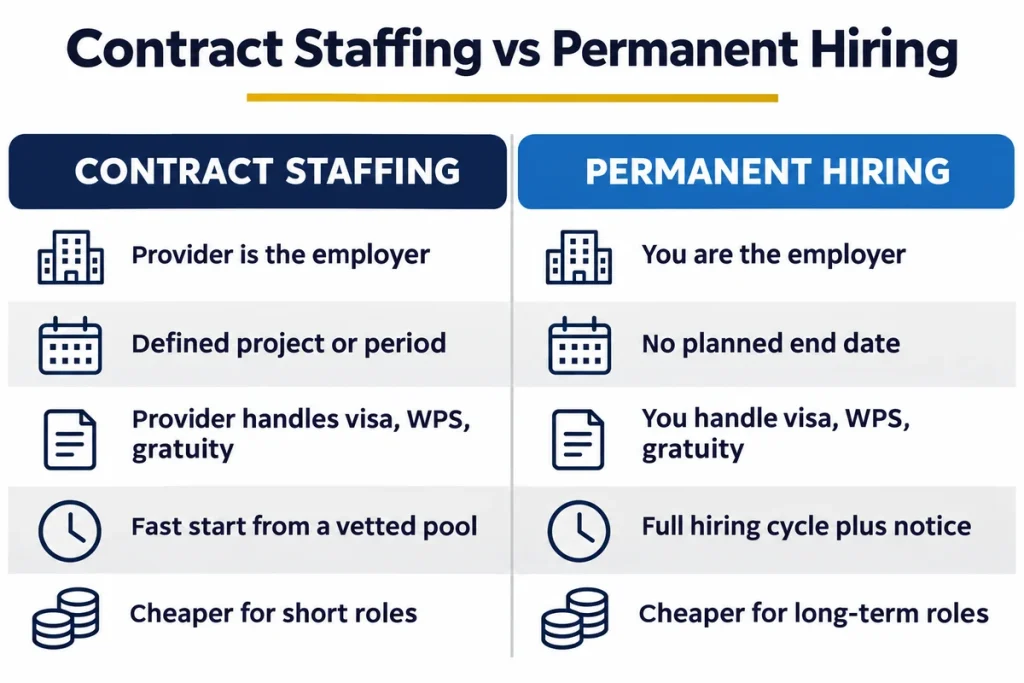
Under contract staffing the provider is the legal employer, handles the visa, WPS and insurance, carries the gratuity and absorbs the recruitment cost into one all-in rate. Starting is fast because the pool is pre-vetted, scaling down carries no redundancy process on your side, and most of the compliance burden sits with the provider. It suits projects, seasonal peaks, fast starts and specialist skills.
With permanent hiring, all of that is yours: the contract, the visa, the payroll, the gratuity and the recruitment bill, paid upfront. Starting is slower, because you run a full hiring cycle and then wait out the candidate’s notice period, and scaling down means notice periods and gratuity. It suits core, long-term, leadership and knowledge-heavy roles.
Neither model wins on every point, which is why most UAE employers use both. Contract staffing companies in Dubai and across the UAE support project work in construction, oil and gas, logistics, manufacturing and facilities management, while shorter and more urgent needs go through a temporary staffing agency in Dubai on the same legal structure.
Where the break-even falls
The monthly rate alone does not settle the cost question, because the two models count costs differently. With contract staffing you pay one rate covering wages, visa and insurance, payroll administration and the provider’s margin, and that margin repeats every month. With a direct hire, salary is only part of the bill: add recruitment and interview time, visa and medical fees, onboarding before the person is productive, gratuity accruing from year one, payroll and WPS administration, and the cost of a vacant role if someone resigns.
Take one technician, on illustrative figures rather than a quote: basic salary AED 4,000 a month plus AED 1,500 in allowances, recruitment at AED 5,500, visa and medical at AED 3,500 one-off, gratuity about AED 2,800 a year, against a contract staffing rate of AED 7,000 a month all-in.
Over four months, permanent hiring costs AED 31,000 and the contract route AED 28,000. Over twelve months permanent hiring costs AED 77,800 and the contract route AED 84,000. So contract staffing is AED 3,000 cheaper at four months, the two break even at about six, and permanent hiring is AED 6,200 cheaper over a year. The gap widens with time because the provider’s margin repeats monthly while your recruitment and visa costs are paid once.
The example leaves out notice periods, idle time between projects and the cost of replacing someone who resigns, all of which favour contract staffing for short roles. Run the numbers for each role with your own quotes.
ILOE: who actually has to enrol
ILOE, the UAE’s mandatory unemployment insurance scheme, is widely misunderstood. Many employers assume enrolment is their job. It is not: the obligation to subscribe sits with the employee. Employers may pay the premium on their staff’s behalf, but they are not required to (Khaleej Times).
The scheme applies to employees in the private sector and the federal government. The premium is up to AED 5 a month for basic salaries under AED 16,000 and up to AED 10 above that. Not subscribing carries a fine of AED 400, and not paying premiums a further AED 200, and those fines fall on the worker (Al Etihad). Unpaid fines can be deducted from salary or end-of-service benefits, and MOHRE can withhold a new work permit until they are cleared (Khaleej Times). Investors and business owners, domestic workers, employees under 18 and employees on temporary contracts are exempt (Dubai government portal).
For permanent hires, confirm at onboarding that the employee has subscribed; at AED 5 a month for most salaries, paying it yourself is a low-cost benefit worth considering. For contract staff, the placed worker subscribes because the provider is the employer, so ask your provider whether it checks subscription or pays the premium. A worker with unpaid ILOE fines can be blocked from a new work permit, which can delay a transfer or a conversion onto your payroll. One point stays open: whether a placed worker on a provider’s contract counts as a temporary-contract employee for the exemption. For long assignments, confirm with MOHRE or the ILOE scheme provider.
Does contract staffing affect your Emiratisation quota?
Possibly, but public guidance does not say clearly whether agency-supplied workers count toward a client company’s own target, so confirm with MOHRE before relying on contract staff to meet your obligations.
According to Gulf News reporting on MOHRE’s announcement, companies with 50 or more workers must raise the number of Emiratis in skilled roles by 2% a year, and companies with 20 to 49 workers in fast-growing sectors must hire at least one Emirati and keep existing Emirati staff. Companies that miss their targets face financial contributions.
The practical question is whose headcount the target is measured against. Quotas are tied to the employer, and an agency-supplied worker is employed by the provider. Until you have confirmation, plan your Emiratisation hiring as if contract staff do not count, ask your provider how it handles Emiratisation for its clients, and keep Emirati roles in your own pipeline. An Emiratisation recruitment agency with an active Emirati talent pipeline can help you fill them.
Seven red flags that your setup is putting you at risk
Misclassification happens when a worker is labelled one way on paper and treated another way in practice, so nobody is clearly the legal employer. The risk can fall on the client as well as the provider.
- No valid MOHRE licence for the activity. Ask for it and confirm it covers the service you are buying.
- A worker with no valid work permit, or on a visit visa. Check the permit before the first shift.
- Salaries paid in cash or outside WPS. Ask for proof of WPS payment each month.
- A “consultant” or “freelancer” working fixed hours under your supervision. Put the person on a proper employment or provider contract.
- You paying the worker directly while an agency sponsors them on paper. Keep one clear employer.
- Workers charged recruitment or visa fees, or having deductions taken. Prohibit worker charges in the contract.
- A “temporary” assignment renewed year after year without review. Review long assignments on a schedule and convert deliberately.
If more than one applies, fix the structure before adding more workers to it. For a longer list of what to check in a provider, see our guide on how to choose the right manpower supply company in the UAE.
When each model wins
Contract staffing wins when the work has an end date or an unpredictable size. An HVAC contractor awarded a project needing 15 technicians for four months cannot wait out fifteen visa processes and fifteen notice periods. A shutdown needs certified technicians for weeks, after which direct hires would sit idle. Hospitality and retail teams grow around Ramadan and year-end. And where a contract may not be renewed, contract staff let you scale down without a redundancy process of your own.
Permanent hiring wins for knowledge-critical roles such as a finance manager, HSE lead or key engineer, for roles you will need for years, where the provider’s margin adds up, and for client-facing and leadership roles where accountability is easier to build in-house. Emirati hires belong on your own payroll.
Most businesses end up with a hybrid: a permanent core, with contract staff for each project phase. If you want to test someone before committing, agree conversion terms with the provider upfront.
Which model fits this role?
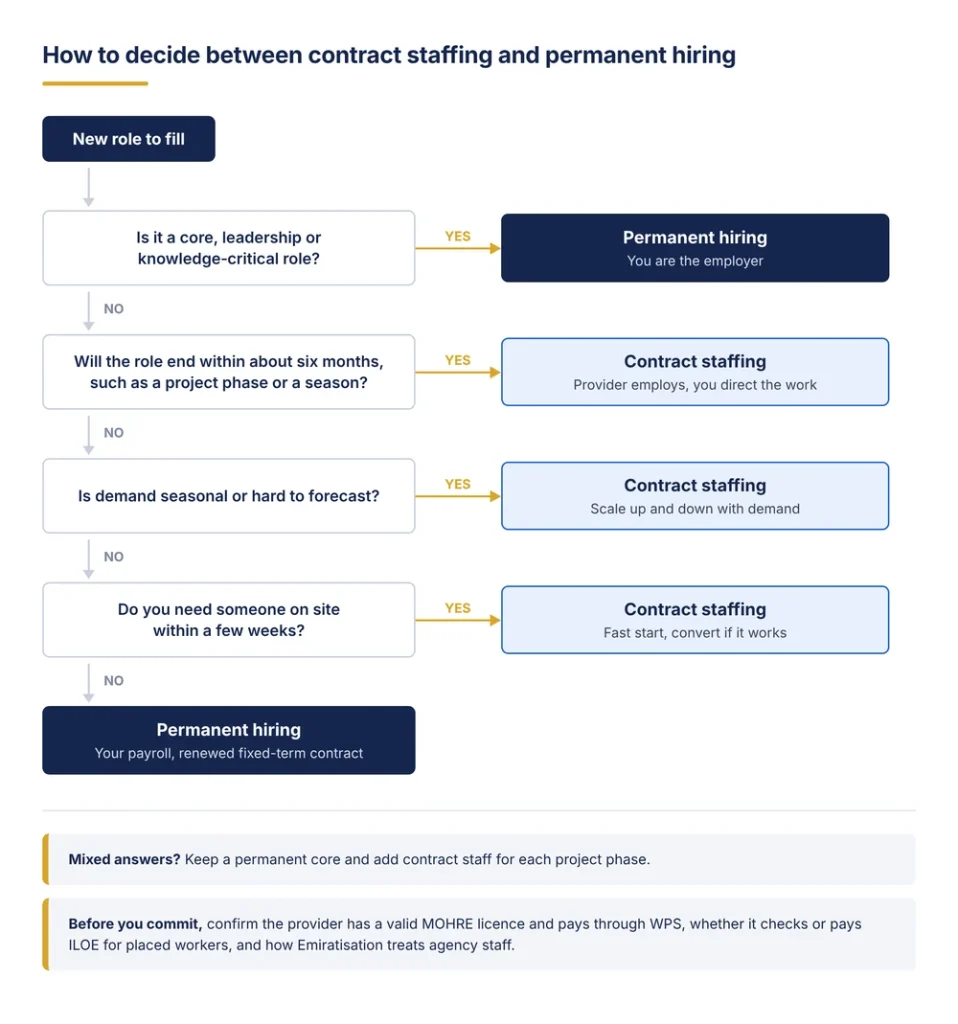
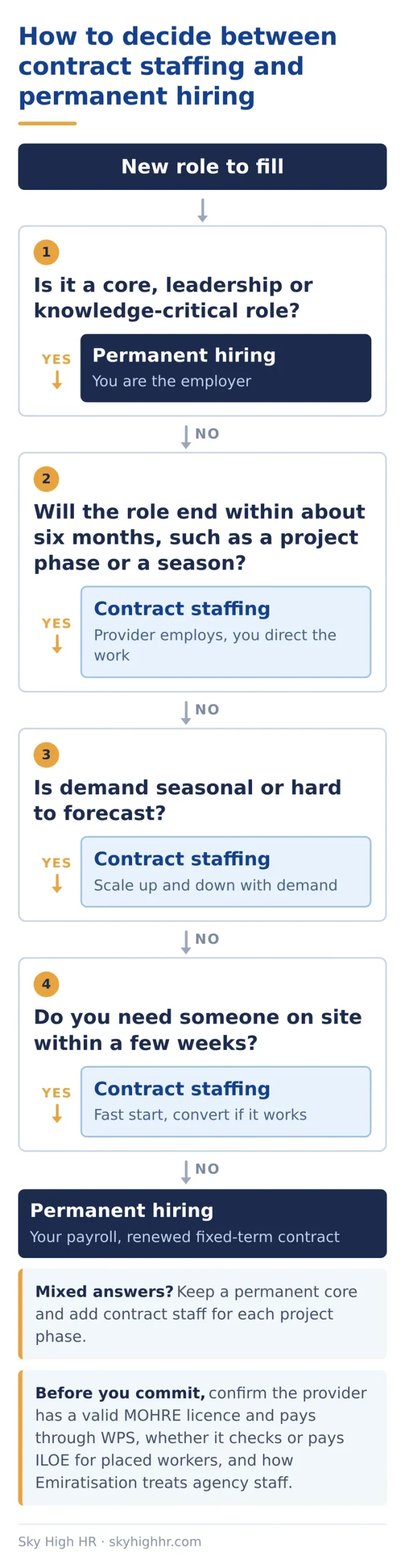
Run each role through four questions in order, and take the first “yes” as your starting answer. A core, leadership or knowledge-critical role points to permanent hiring. A role ending within about six months, or with seasonal or uncertain demand, points to contract staffing. If the answers are mixed, use a hybrid.
Licensed in DIFC or ADGM? Read this first
Free zone employers follow their own employment law, not the mainland rules above, so rebuild the cost comparison on your own regime. Open-ended contracts are still allowed in both DIFC and ADGM, which makes a permanent hire there genuinely permanent. DIFC employers generally use the DIFC Employee Workplace Savings plan in place of gratuity, paying 5.83% of basic wage for the first five years and 8.33% after. Under ADGM’s Employment Regulations 2024, employees are entitled to gratuity when employment ends, employers may offer a savings scheme instead, and probation cannot exceed six months. Before you commit, confirm how a provider’s licence applies when workers are placed with a free zone entity, and whether ILOE applies.
Why Sky High
Sky High has supported UAE employers for over 30 years across contract staffing, temporary staffing, RPO, Emiratisation, and visa and WPS payroll services, with more than 35,000 placements delivered across public and private sector clients in the UAE. We are ADNOC pre-qualified, TAQA approved and recognised under the UAE In-Country Value programme, with offices in Abu Dhabi and Dubai supporting employers across construction, oil and gas, logistics, manufacturing, marine and offshore, and infrastructure sectors. Learn more about Sky High.
Frequently asked questions
Is there a permanent employment contract in the UAE?
Not on the mainland. Since 2 February 2022, Federal Decree-Law No. 33 of 2021 requires fixed-term contracts, so a “permanent” hire is one whose fixed-term contract keeps being renewed. DIFC and ADGM still allow open-ended contracts under their own rules.
What is contract staffing?
An arrangement where a licensed provider employs workers and places them with a client for a defined project or period. The provider handles visas, payroll, WPS and insurance, and the client directs the daily work.
Is contract staffing cheaper than permanent hiring?
Usually for short or uncertain roles, because recruitment, onboarding and exit costs are avoided. For roles lasting a year or more, permanent hiring is often more economical, because the provider’s margin accumulates every month.
Who has to enrol in ILOE, the employer or the employee?
The employee. Subscription is the worker’s own obligation and fines for not subscribing fall on the worker. Employers may pay the premium on their staff’s behalf but are not required to. Workers on temporary contracts are among the exempt categories.
Can a contract worker convert to permanent?
Yes. Many providers offer a conversion process. Agree the conditions and any fee in your contract before the assignment starts.
Does contract staffing affect Emiratisation quotas?
It may, but it is not clear-cut. Public guidance does not state whether agency-supplied workers count toward a client company’s own target, so confirm with MOHRE before you plan around it.
Still weighing contract staffing against permanent hiring for your next role? Get in touch with Sky High HR and we will show you the cost both ways.


1 Comment